Monday, October 31, 2011

Kenyan Cincinnati Association (KCA) Annual Dinner 2011

The Kenyan Cincinnati Association (KCA) looks forward to welcoming The Kenyan Ambassador in Washington DC USA H.E. Elkanah Odembo, and fellow Kenyans to the events that will be taking place next weekend, Saturday November 5th and Sunday November 6th, 2011. We would like to encourage Kenyans around the Tri-State area (Indiana, Kentucky, and Ohio) to plan to participate in both events. The Ambassador will be highlighting some important information during his speech as the guest of honor at the Annual KCA dinner and has requested to meet with Kenyans from the Tri-State area to address some concerns affecting Kenyans within the Diaspora. In addition he would like to address the setting up of "The Diaspora advisory committee" (Midwest region) to serve as an important link between the Kenyan population in the Midwest region and the Embassy. Therefore, we urge and encourage Kenyans to take advantage of this opportunity and attend both events (dinner and conference) and to please confirm via email, phone, or text as this will further help us plan some logistics of the events.

Thank you and we at KCA look forward to welcoming you all.

Sincerely

Daniel C. Odipo
(Chairman KCA)
P/S: If you need help with making accommodation reservation, please let us know through the email below or facebook message.

For more information contact KCA at info@kcaweb.org see more informstion at http://www.kcaweb.org and facebook event page at https://www.facebook.com/david.mutua#!/event.php?eid=264199360289536

Saturday, October 29, 2011

Zawadi Africa Education Fund

The Zawadi Africa Education Fund is a program designed to provide scholarships to academically gifted girls from disadvantaged backgrounds from Africa to pursue higher education in the US. The Zawadi Africa Education Fund is based on the highly successful Kennedy/Mboya Student airlifts of the 1960's, through a partnership with individuals and institutions with an interest in creating leadership

Background
  • The Africa student airlift program was created in 1959 by the late Tom Mboya, one of the architects of the Kenyan independent movement, to provide a pipeline of young African leaders to staff the newly formed government and parastatal organisations that would be left behind as European colonial officials returned to their home countries, post independence.
  • The late Tom Mboya funded the program through appeals to US Universities, and via private and public US donors including the US State Department, the Kennedy Foundation, and several US luminaries of the Civil rights movement, including John F. Kennedy, Martin Luther King, Jackie Robinson, Harry Belafonte, Frank Montero and William Scheinman. US colleges and universities provided full scholarships, while the program sponsors paid for airfare and student upkeep. From 1959-1963, Mboya sent a total of 1000 students to US universities.
  • The program was highly successful, providing a pool of graduates that went on to become the leaders of the young governments in East Africa. Over 80% of East Africa's immediate post-independence leaders were graduates of the student airlift program, including Kenya's Professor Leah Marangu the Vice Chancellor Nazarene University, Professor Wangari Mathaai, Africa's first Nobel Peace prize Laureate, and Barrack Obama Sr., father of Senator Barrack Obama of Illinois, to name a few.
  • Although the program included women, the post-independence move to self- actualization largely bypassed the women of the region. While women represent 50% of the African population today, they constitute less than 2% of the region's government leaders. African women are prevented from pursuing a higher education by the tremendous financial burden on their families, opposing customs/traditions, including early childhood marriages, and the cultural expectation that they will be first and foremost wives and mothers.
  • In 2002, Dr. Susan Mboya, daughter of Tom Mboya, created the Zawadi Africa Education Program to help young African women obtain a college education. This pilot program was loosely based on the 1960's student African Student Airlifts. As with the original airlifts, the program pairs US universities with talented but needy young women from East Africa.
  • · Importantly, the Zawadi Africa Education Fund has delivered an excellent return in its first few years. To date, there are a total of 55 students enrolled at top universities in the US including Yale University, Xavier University and Smith College. The students in the program have an average GPA of 3.70. This is made even more impressive by the fact that the students are all required to be partners in this initiative, by holding down on- campus jobs to pay for books and incidentals. On average, the program pays for less than 10% of the total cost of a 4-year education, with the balance funded by merit based college grants and scholarships.  

Friday, October 14, 2011

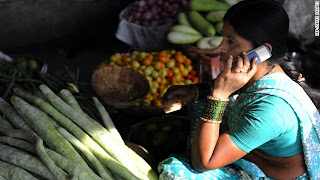
Mobile phone: Weapon against global poverty

Indian vendor using her mobile phone to take customers orders
(CNN) -- When renowned economist Jeffrey Sachs visited rural villages in sub-Saharan Africa in 2005, he saw impoverished communities with poor drinking water, feast-and-famine crop cycles and rampant malaria infections. What he didn't see was mobile phones.

"Now mobile phone ownership is perhaps 30% of households and cell phone coverage is widespread," said Sachs, director of the United Nations Millennium Villages Project, which focuses on improving 14 rural villages across 10 African countries as a model for wider prosperity in the region.
The advent of the mobile society may have brought convenience and a cultural sea change to the U.S. and Europe, but in the poorest regions of the world, affordable mobile phone access has caused a quantum leap in services -- like calling for medical help, sending a quick letter to loved ones or starting a savings account -- that Americans and Europeans have taken for granted for generations, analysts say.

"The cell phone is the single most transformative technology for development," said Sachs, head of the Earth Institute at Columbia University and author of the 2005 book "The End of Poverty."
"Poverty is almost equated with isolation in many places of the world. Poverty results from the lack of access to markets, to emergency health services, access to education, the ability to take advantage of government services and so on," Sachs said. "What the mobile phone -- and more generally IT technology -- is ending is that kind of isolation in all its different varieties."
 
There's probably more pervasive coverage in Kenya than in many areas in Europe
Michael Joseph, former CEO of Safaricom

Moreover, the profusion of payment services via cell phones puts places like Kenya and Uganda in the vanguard of mobile financial services. "You can walk in the middle of rural village in Rwanda and use a mobile phone to pay at a recharging station to recharge LED lights," says Amanda Gardiner, acting program manager of Business Call to Action, a New York-based non-profit organization that is helping to bring more mobile phones to Africa's rural poor.
"I'm always flabbergasted I don't walk into Home Depot and see these services here, just swipe your cell phone and go," Gardiner said. "In some ways, they're really leaping ahead of us and going right to the future."

Kenya's "mobile-money" revolution
From 2005 to 2010, cell phone use tripled in the developing world to nearly 4 billion mobile subscriptions, according to the International Telecommunications Union (ITU). Nowhere was the growth faster than in Africa, which saw mobile use grow more than 400% during that time frame, according to ITU. That means more money -- a 2006 University of Michigan study found that every 10% increase in cell phone penetration grows the local economy by 0.6%.

The simple ability to make a phone call has far-reaching economic consequences, Sachs said.
"Places where traditionally, people would walk livestock for a week or two without knowing what kind of price they'll fetch -- should they go to Khartoum, Nairobi or Port Saeed? Now they can call ahead and find out where to get the best price," Sachs said.

The low cost of setting up mobile towers and plunging costs of handsets has allowed cell phone coverage to grow even in poor, rural locations, said Michael Joseph, former CEO of Safaricom, a Kenyan telecom provider which grew from 17,000 users when he started in 2000 to more than 18 million when he stepped down in 2010.

"There's probably more pervasive coverage in Kenya than in many areas in Europe," Joseph said.

Business models set up for selling services to the poor -- such as buying pre-paid phone service and charging by the second rather than the minute -- made cell phone use affordable, but Safaricom's development of banking services via cell phones revolutionized the telecom business in poor countries.
In some ways, (Africa) is really leaping ahead of us and going right to the future
Amanda Gardiner, acting program manager of Business Call to Action
Safaricom, in partnership with the U.K.'s Vodafone, started M-PESA (short for mobile pesa, Swahili for "money") services in 2007 that allow customers to digitally transfer cash via mobile phones. Two years later, 10% of the country's GDP was being circulated through M-PESA, according to a 2010 World Bank report. Now Kenyans make $1 billion a month in transactions via M-PESA, where cash can be deposited and transferred at one of 20,000 stores, Joseph said.

"The growth of GDP in Kenya would be half what it was the past 10 years if it wasn't for the mobile phone," said Joseph.
"
About 70% of all jobs in Kenya are in the informal sector -- selling goods on the side of the road, that sort of thing -- and now to start a business all you need is a cell phone," said Joseph, who now is a fellow at the World Bank focusing on mobile money services.

As a result of M-PESA, more cash is moving -- and staying -- in smaller villages, building up the local economy, said Olga Morawczynski, who spent 18 months in Kenya studying the impact of mobile banking services there.

"Now that money is being delivered locally, they didn't have to physically go to the nearest urban center to get cash," said Morawczynski, who is now working in Uganda on mobile banking programs for the Grameen Foundation's AppLab program. "I noticed village stores had seen a demand in 'city goods' -- things you wouldn't typically get in the villages before like furniture, or a particular hair-straightening product for women.

Mobile apps for poverty
Cell phone technology has unleashed new ways to help the poor in developing countries, Sachs said, but businesses have led the way.
"Cell phones are spreading almost entirely on a market basis ... only now are we starting to get the applications for it on the social services side," Sachs said. "And the genius of prepaid phone cards has made it possible for the poor to gain access to this technology without government involvement ... it's largely governments stepping out of the way and letting commercial companies come in."

Safaricom's mobile banking model is being brought to areas from Bangladesh to Uganda. The United Nations Development Bank last month announced a program to bring mobile phone service to 3 million more poor people in Africa and South Asia by 2013. Mobile technology is now being used in Gambia to track medication stock levels in rural villages, Gardiner said. For the UN Millennium Project villages, the pre-paid mobile card is now being used as a model for pre-paid electrical service.
"We're able to do very quick mapping and needs assessments with smartphone with GIS capability," said Sachs, project director. "We can cover an area of assessment in weeks, something that used to take years."

"The most powerful thing about cell phones is how it has released money flow incountries that have poor infrastructure and often are in crisis situations," Morawczynski said.
"It also teaches people terms such as 'pin number', 'account', and 'transfer,' these kind of technical foreign terms that serve as a nice transitional toward using financial banking services for the first time. People are realizing it's better than keeping money buried in the ground."

Wednesday, October 5, 2011


U.S. Delegation on Food Security Travels to Horn of Africa

Media Note
Office of the Spokesperson
Washington, DC
October 4, 2011

Secretary of State Hillary Rodham Clinton has asked USAID Administrator Raj Shah to visit Ethiopia and Kenya to discuss key agricultural and food security issues and demonstrate the United States’ continuing stalwart commitment to provide urgent life-saving aid to the populations affected by the current famine in the Horn of Africa.
This delegation includes Administrator Shah, U.S. Ambassador to the United Nations Food and Agriculture Agencies in Rome Ertharin Cousin, and Acting Special Representative for Global Food Security Jonathan Shrier. The delegation is traveling to Kenya and Ethiopia October 4-5. They will meet with government officials and civil society and private sector representatives to discuss progress in the region and impediments to securing unfettered humanitarian access to the at-risk populations in Somalia and those in camps in Kenya and Ethiopia. Since emergency assistance alone cannot solve the underlying long-term problems, the delegation will also visit programs that demonstrate how Feed the Future projects are supporting local efforts to increase resilience among vulnerable populations.

On September 23, 2011 at the United Nations, Secretary Clinton announced an additional contribution of approximately $42 million in humanitarian assistance for the Horn of Africa, which includes $30 million for efforts in Somalia. The United States is the largest donor of humanitarian assistance to the region, now providing approximately $650 million in life-saving assistance to help nearly 4.6 million people in need.
For more information check - http://www.state.gov/r/pa/prs/ps/2011/10/175013.htm